1/09/2015

Cape Verde April 2014 - Part V: Santo Antão

//To the first post about Cape Verde (Santiago: Praia)//
//To the second post about Cape Verde (Road trip Santiago)//
//To the third post about Cape Verde (Santiago: Tarrafal)//
//To the fourth post about Cape Verde (Mindelo)// 

After enjoying a few very nice days in Mindelo, we took the ferry to Santo Antão. This small island is often said to be the hikers's paradise of Cape Verde, and so it was clear from the beginning that we would visit it. The ride took about one hour with the new speed ferry, it's a big boat where the passengers sit in a room that looks a bit like a cinema, row after row of plushy padded chairs, you're not allowed to be outside, so no enjoying the fresh, salty air. We were very happy to arrive in Porto Novo - but this didn't have much to do with the sea being quite agitated. The worst thing about this ferry were the TV screens in front of the huge passenger room, showing really bad music videos, including sound, of course. There was no escape. I normally don't get seasick, and I'm more or less sure my nausea when arriving in Porto Novo wasn't entirely caused by the waves.
Santo Antão is small, and we had decided to stay in Ponta do Sol for three days - it's on the opposite coast from Porto Novo. We didn't want to rent a car there because the guidebook said that it was not a problem to get around with Aluguers. One of them brought us along the coast to Ponta do Sol. The views from the route are breathtaking, the road runs along beaches and on top of cliffs, crossing through the valley of Paúl, where the dry and scraggy red stone which dominates much of Santo Antão's east and southeast part, is suddenly replaced by jungle-like forests and little streams. Ponta do Sol is on the northern tip of the island, the northernmost point of Cape Verde.


I have written about the colonisation of the southern Cape Verdean islands (Sotavento) earlier, where the geographical location turned out to be an advantage in the slave trade. The northern islands (Barlavento) were far from the slave traders' routes and mostly served for growing and exporting agricultural products. This is the reason why the creole culture in the northern islands has different roots, the influence of the first generations of african slaves which was very strong especially in Santiago is missing here. Instead, families from Portugal were brought here by Santo Antão's owners to work as farmers, starting in the 17th century. Later immigrants came out of very diverse reasons, they were exiles, soldiers, refugees, castaways and sailors from European countries and from North America. Interestingly, a lively jewish community developed on Santo Antão, there are still jewish cemeteries to see today and there's a village called Sinagoga.
The economic growth on Santo Antão came to a sudden halt when the island was privatised and given to a trade company in 1757 and the farmers were forced to cultivate grapes and produce wine for the slave trade stations. Only a few years later, landslides destroyed the vineyards. In the following years, half of the population died of hunger and a royal decree ordered the company give the island back to the count and his family who'd owned it before.
Until today, Santo Antão is one of the poorest islands in Cape Verde, despite the fertile soil and the climate. Most of the farmers don't own their land, they rent it from landlords who sometimes don't even live on the island. They produce sugar cane which is used for "grogue", the famous Cape Verdean rum. Sugar cane does not need continuous care, so the farmers only have work for parts of the year and many of them can't make a living for their families - they of course have to pay the rent fees all year round. Maybe some of them would grow food plants, but this is a huge problem on Santo Antão. The reason is a millipede, first found in Cape Verde in the 1970, which feeds on the roots of almost all food plants - but not on sugar cane.

We hadn't booked a room in advance in Ponta do Sol because this had turned out to be difficult as most of the smaller hotels mentioned in our guidebook don't have a website or we were not able to book online. So we took a walk through the town to find a nice hotel. When we saw the entrance to "Kasa Tambla", we immediately knew we'd like the place. But then they told us there were no free rooms - only the suite. It was more expensive, but the receptionist offered to show it to us, and when we stood on the terrace, admiring the view over the the sea towards the cliffs, we didn't need any more reasons to stay. It's an incredibly beautiful, calm place where we spent hours of talking about our experiences in Cape Verde, writing postcards and enjoying dinner - or just sitting there waiting for the sun to go down.


On our first day in Ponta do Sol we did a really nice hike to Fontainhas. This is the last village along the cliffs still accessible by car, and of course the Aluguers bring you there if you like. But walking is much nicer - stunning views, the sea deep below, looking back towards Ponta do Sol from different angles, then seeing Fontainhas from far away, the houses seem to be glued to the rock. It has been a fantastic day, out in the sun.


In the evening we went to the harbour, which is called "Boca de pistola", the "pistol muzzle". The name stems from the harbour's dangerousness for the fishermen and their small boats. It's a natural harbour surrounded by a stone wall. In the evening there was not much action though, people met at the harbour, and we had dinner in a nice little restaurant before exploring the old landing strip. One of the most interesting things about Ponta do Sol is the former airport. It opened in 1983 and closed only a few years later. The runway is still there, though, and the people use it as outdoor gym.


The next day it took us about an hour to get to Vila das Pombas, the starting point for hikes in the Paúl valley. One of the Aluguer drivers offered to bring us there but as not many people want to go there from Ponta do Sol, so she didn't want to wait and told us we'd have to pay the taxi price. In the end we took another Aluguer to Ribeira Grande and from there took one to Vila das Pombas. We never used an Aluguer as taxi, and we never rented one (including driver) for a day, often they ask higher prices from tourists than they would from Cape Verdean people for taxi service (Cape Verdeans rather wait until the Aluguer is full than pay the taxi price). So while you could think that you help the driver when paying higher prices and having the Aluguer for yourself, in most cases this is not necessary (because you can get almost everywhere with Aluguers if you have enough time) and it eventually leads to higher prices for locals, too. There are normal taxis (not in the small villages though) - Aluguers aren't taxis. When you use the Aluguers like the locals do you support their public transport system and thus the drivers, too.


Our hike in the Paúl valley was really nice. The valley is green as a jungle, they even grow tomatoes there - and almost all other kinds of fruit and vegetables. Our path led steeply upwards, and we saw fascinating plants along the way, amazing flowers and trees. We also met a centipede, one of the very few poisonous animals in Cape Verde - we should probably feel honoured, our guidebook said they are rarely seen alive. Well, they are not exactly the most beautiful animals I've seen. But... interesting.


We passed by a big reservoir, probably used for watering the nearby bananas, children were swimming and playing in the water and when we walked towards them started to yell "money, money" at us. This always made me sad, but fortunately, most of the kids (at least the younger ones) don't get angry when you don't give them anything.


A while later we found out that we had misinterpreted our map and were much farther from our destination - a village high above the valley - than we'd thought. We'd probably need two more hours to get there, and then about five hours back to Vila das Pombas. We definitely didn't have enough water for such a long hike anymore. A young man caught up with us and we tried to ask him if there was a restaurant or a shop in the village where we could buy more water, but we didn't find a common language and after the "conversation" we didn't want to risk anything. The tap water in Cape Verde is not drinkable, we always filtered it. So we decided to stop and turn back. A pity, as we really enjoyed the hike, but in a tropical climate you certainly don't want to risk running out of water when doing outdoor sports.
Back in Vila das Pombas, I drank the best Coke of my life. Honestly, it never tasted better.


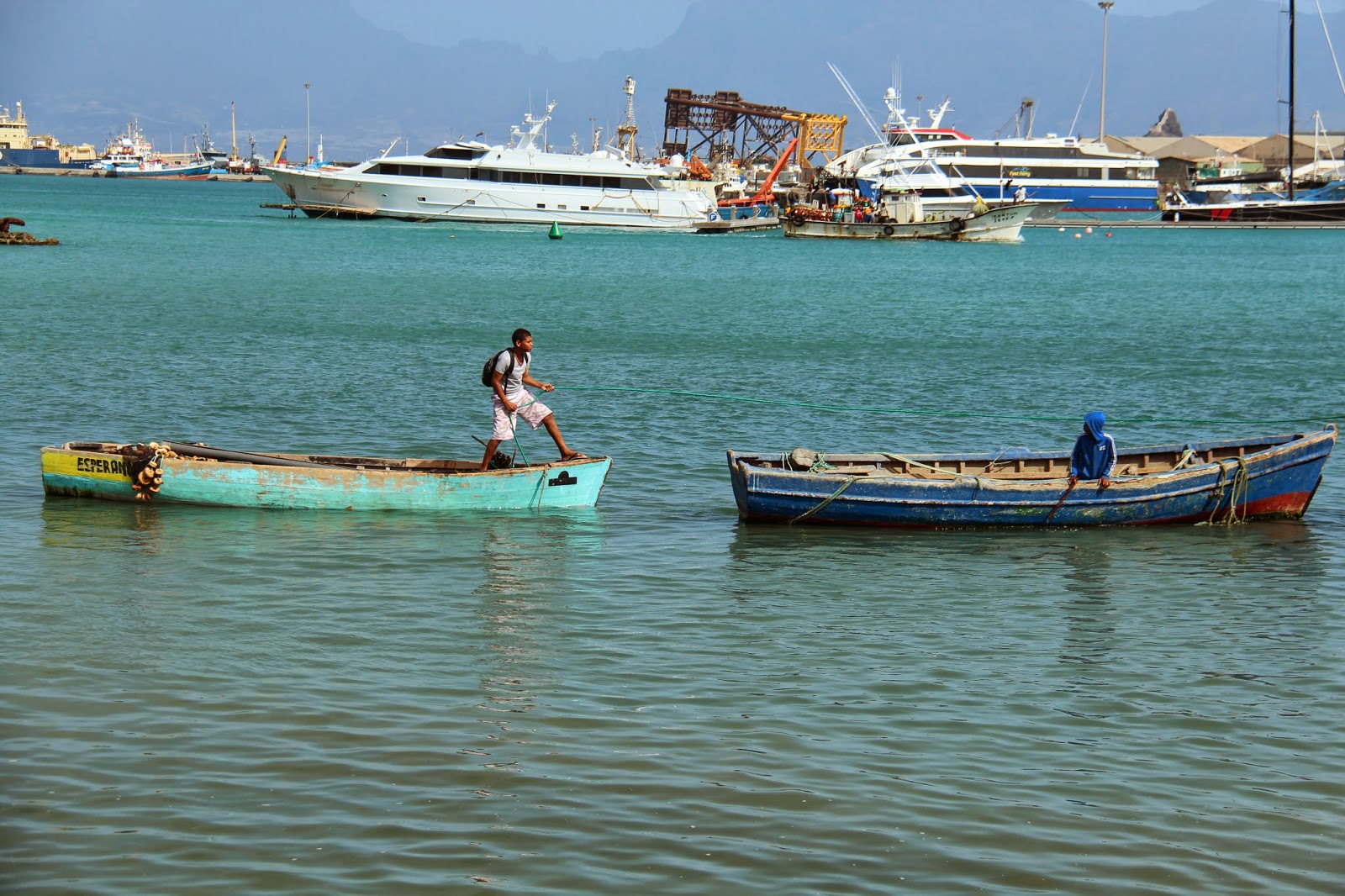
On our last morning in Ponta do Sol we went down to the harbour to watch the fishermen coming back. The port entrance is narrow and the waves quite high, so the fishermens' skills maneuvring the boats are remarkable. As soon as a boat is safely inside the harbour, the men help each others bringing it ashore. Next, they unload their catch and bring the fish to the stone table with the scales, where the women weigh them before they are sold. I really liked watching and taking photographs - surely one of the highlights of this trip.


We said goodbye to Ponta do Sol and took an Aluguer back to Porto Novo, where the ferry back to Mindelo waited for us. This time we took the older one, no bad music videos - and we could spend the ride outside on deck (together with a lot of tourists). We had not even left the harbour when a staff member came and distributed barf bags (before I continue telling this story: barf bag is a word I didn't know in English and when asking the dictionary - the German word is "Kotztüte", by the way - I also found a link to this fantastic website with an international collection of barf bags...) - we thought they'd probably seen their fair share of seasick tourists and don't want to take any risks. As I said, I normally don't get seasick, and I am very proud that I survived this boat trip without feeling nauseous, too. But it's been a challenge. The sea was very agitated this time and the ferry seemed to capsize every moment (that's how it felt and looked, anyway). It was impossible to stand without holding on to something, and even sitting down I had to grab the rail behind me every now and then to prevent slipping from my seat. The photos below are taken about ten seconds apart.


We spent another night at Hotel Gaudi in Mindelo (in the same room, so - one more time we took a shower sitting down in the tub to increase water pressure...) - before we began our long journey home. One hour flight to Sal, three hours waiting on the airport until the flight to Lisbon took off, landing in Lisbon before seven in the morning. I barely slept during the flight and was dead tired when we finally landed. The airline had postponed our flight back to Geneva and we'd tried to get on an earlier one, but it would've cost half a fortune, so we deciced against it in the end. I absolutely didn't feel like waiting for another seven hours, but we didn't have a choice. My mood was really bad by then, but fortunately, Monsieur is disaster-proof and had a very, very good idea: he went to the information counter and asked for a hotel offering room for only a few hours. And we were lucky: the TRYP hotel was brand new, offering rooms for half a day - and just across the street. I had the best shower in my life so far and we slept for four hours before going back to the airport, having lunch and - finally - boarding our plane to Geneva.

I will surely never forget this first time outside of Europe. Some situations keep coming to my mind from time to time, good experiences and moments like tasting new food and laughing with an Aluguer full of different people, from businessman to market woman, about the driver who in the middle of the road just got out of the Aluguer to pee behind a stone wall on the roadside. I still have the images of the incredible beaches in my mind, the sound of the waves. But I also remember the children yelling "money, money" at us and the teenagers blocking our way and trying to open the car doors to provoke us. I can understand why they did it, but still - the feeling of vulnerability and panic will stick with me.
Above all I will remember the stunning, beautiful nature of Cape Verde, and all the kind people we met, guiding us, helping us, talking to us, asking us questions about our country and discussing our histories. We have not yet seen all the islands, there's surely enough to see to come back one day. I hope we will have the chance to.


11/09/2014

Cape Verde April 2014 - Part IV: Mindelo

//To the first post about Cape Verde (Santiago: Praia)//
//To the second post about Cape Verde (Road trip Santiago)//
//To the third post about Cape Verde (Santiago: Tarrafal)//


After more than a week on the road, discovering Santiago island, we took a flight to Mindelo. Mindelo is the principal town of São Vicente, and many say it's Cape Verde's secret capital. São Vicente is one of the Ilhas de Barlavento, the northern part of the country, about 200 km from Santiago. The flight takes less than one hour, but as regular readers of my blog might know, I don't like flying very much, despite many months of confrontation therapy. And while some people might enjoy flights in unusually small planes at night, with the lights in the cabin off and nothing at all to see outside the windows - well, I don't. But we landed safely and took a taxi to get to our hotel. Because we knew we would arrive late at night, we had booked in advance. Hotel Gaudi is one of the hotels in Mindelo offering european standard, and while our room was smaller than we expected, it was clean and the staff at the hotel was very friendly. So we were looking forward to a nice weekend in Mindelo - in hindsight definitely one of my favourite places in Cape Verde..


After a not so calm night (weekend nights in Mindelo are party time, obviously), we enjoyed the breakfast at the hotel's restaurant very much - papaya salad with goat cheese became one of the things I will always remember when thinking about this trip, so yummy!

We started our stay in Mindelo with a walk along the bay, shortly visiting the fish market (not my favourite place), getting lost in the alleyways between colonial-style buildings, coming back to the harbour (to check out the ferry schedules and see the rescue boats - Monsieur can't pass by any emergency vehicle, I assume this is called déformation professionnelle), and when we already thought about returning to the city centre we arrived at this incredible beach. White sand, turquoise sea, it could be a tropical paradise - if not for industrial companies right on the other side of the street. For me this is another example of how tourism does not really work yet in Cape Verde - of course the noisy and ugly industrial buildings have to be somewhere, but does it have to be right where most tourists will stand in awe and stare at this wonderful beach? We tried to ignore this contradiction and enjoyed the white sand and warm water very much, finally we could go for a swim again!


Back in the city, we were hungry, and it didn't take us long to find Casa Café. It's a really nice place, good coffee and some traditional dishes - of which you should have tried at least the Cachupa. Cachupa is Cape Verde's national dish, but in case you're looking for recipes, I think there are more than you can count and it is served in many different ways. I ate it in different locations and liked the one at Casa Cafè the best as it reminded me of the traditional meals from the region where I grew up - not because they taste the same, but because they follow the same principle: they are made of the things even poor people always had around, like flour (of different sorts), potatoes - adding whatever kind of (cheap) meat and vegetables you have at hand. I think there are so many different versions of these dishes because they have been varied by people who didn't have all ingredients at hand. And still they are considered traditional =) Yesterday's Cachupa is often fried in the morning and enjoyed for breakfast. I must admit I didn't try this...

Compared to Praia or even Tarrafal, Mindelo felt very different to us. The atmosphere is more lively, the city seems to be more welcoming. Some people say Mindelo is more "european", and I'm not exactly sure what they mean by this, but I still can understand why they say it. The history of São Vicente (and thus, Mindelo) is shaped by other milestones than Santiago's. Discovered in 1642, the very small island has only been used by the farmers of neighbouring Santo Antão as pasture for their livestock. The lack of water makes São Vicente difficult to live on, so it was more or less uninhabited, except for pirates who used the natural harbour as their hideout. The 19th century brought new people to São Vicente: Mindelo became a coal deposit for the steam boats of the British East India Company and later for the Royal Mail Steam Packet Company. Mindelo had about 1400 inhabitants in the 1850s, and when the first submarine communications cable was laid between Europe, Africa, India and North America, the city became an important communications centre for the British empire. Mindelo has seen people from all over the world, mostly seamen, and has become a cultural melting pot - while, for example, Santiago's diversity today originates mostly in slave trade. I don't know if these facts are able to still influence the atmosphere of a city, but to me Mindelo seems to be much more open towards people from other countries than Praia. Certainly the expats living in Mindelo make part of the difference, but then again there must also be many of them in Praia, the capital, with all the diplomatic and governemental institutions...


Talking about cultural melting pot, it would be a sin to write about Mindelo and not mentioning her: Cesária Évora. If you've never heard the name: don't google her. But next time you feel tired of living in a rainy, grey place kept hostage by European autumn or winter, lay down on your bed or in your armchair, click on this video and listen to Cesária Évora for 90 minutes. You might want to pack your bags and go somewhere warm afterwards, but your heart will be full of Cape Verdean sun for a while. Promise!

Mindelo shows the signs of decades of English colonial life - but the portuguese influence is clearly visible as well. Starting our tour at the fish market, we noticed it right away: the building that tries to look very portuguese.

If you've never been to Lisbon, you might not realise which building this one is meant to look like, the Torre de Belém. The one in Mindelo is also called Torre de Bélem, the portuguese built it because they didn't want the city to look too English. Nice try, but the tower in Mindelo really can't be compared to the one in Lisbon, which is one of the most fascinating buildings I have ever visited.

Walking along the seashore in Mindelo, we saw two monuments we wanted to know more about. Thankfully, our guidebook was well informed. 


Both of them want people to remember the story of Gago Coutinho. He was an aviatic pioneer from Portugal and the first to cross the South Atlantic Ocean by air, from Lisbon to Rio de Janeiro (together with Sacadura Cabral in 1922). But why are there two monuments for this in Mindelo? Their plane didn't have enough fuel capacity to do the whole trip in one leg, so several stops were required. The one in Mindelo, however, was not intended from the start, but caused by technical problems. Thinking about how easily we cross the Atlantic in airplanes today, it is incredible that this adventure happened less than 100 years ago. They had to do emergency stopovers on small islands somewhere in the ocean and once they had to be rescued by a freighter because they had been forced to land on water in the middle of nowhere. They couldn't finish their journey with the airplane they started with, in fact they needed three of them! You can read a summary of this fascinating story here. And, even more interesting (I think) - here you can find some photos from when the two adventurers were welcomed in Mindelo.

It is not surprising that the beautiful colours of the sea often bring Mindelo's visitors back to the shore, but there are other interesting places to discover. For example Praça Amílcar Cabral (more about him in my last post), a square full of history but still very lively today. There you can find the museum of traditional arts, which we visited out of curiosity. It was really worth it. The building itself is stunning, and the exhibition shows a lot about Cape Verdes history and traditions. I like the Pano d'obra and was very, very tempted to buy one, but then again the women of Cape Verde wear it around their hips - and this would not be suitable for everyday life in Europe, I'm afraid. You can find more about the museum here (in French, but look at the pictures!).


Mindelo's indoor market is the most beautiful I have seen in Cape Verde, the building itself is worth seeing, and in there you can find a huge choice of fruit and vegetables as well as everything else you need to cook fresh dishes - including meat and fish. We bought piri piri chilies as a present for our friends and family members who like to cook, and the encounter with the market-woman who sold them was really funny and a good example for how communication works if people are open-minded and friendly, even if they don't understand each others' language. I asked the woman about the price for one of the little bags with piri piri and she showed me with her fingers, saying the number in portuguese (which is more or less as much as I understand, numbers up to ten, hello and good bye =) - and I told her I want to have three. When I wanted to give her the money, she didn't have the coins to give me the change, and just when I wanted to tell her it was okay, she gave me another bag of chilies and put my money in her pocket, laughing. It was a good deal - I only paid half the price for one of the chili bags - but the situation itself was really interesting and touching.
Later we stepped up to the second floor of the building. From up there, you have the nicest view on the market life, I could've watched for hours.


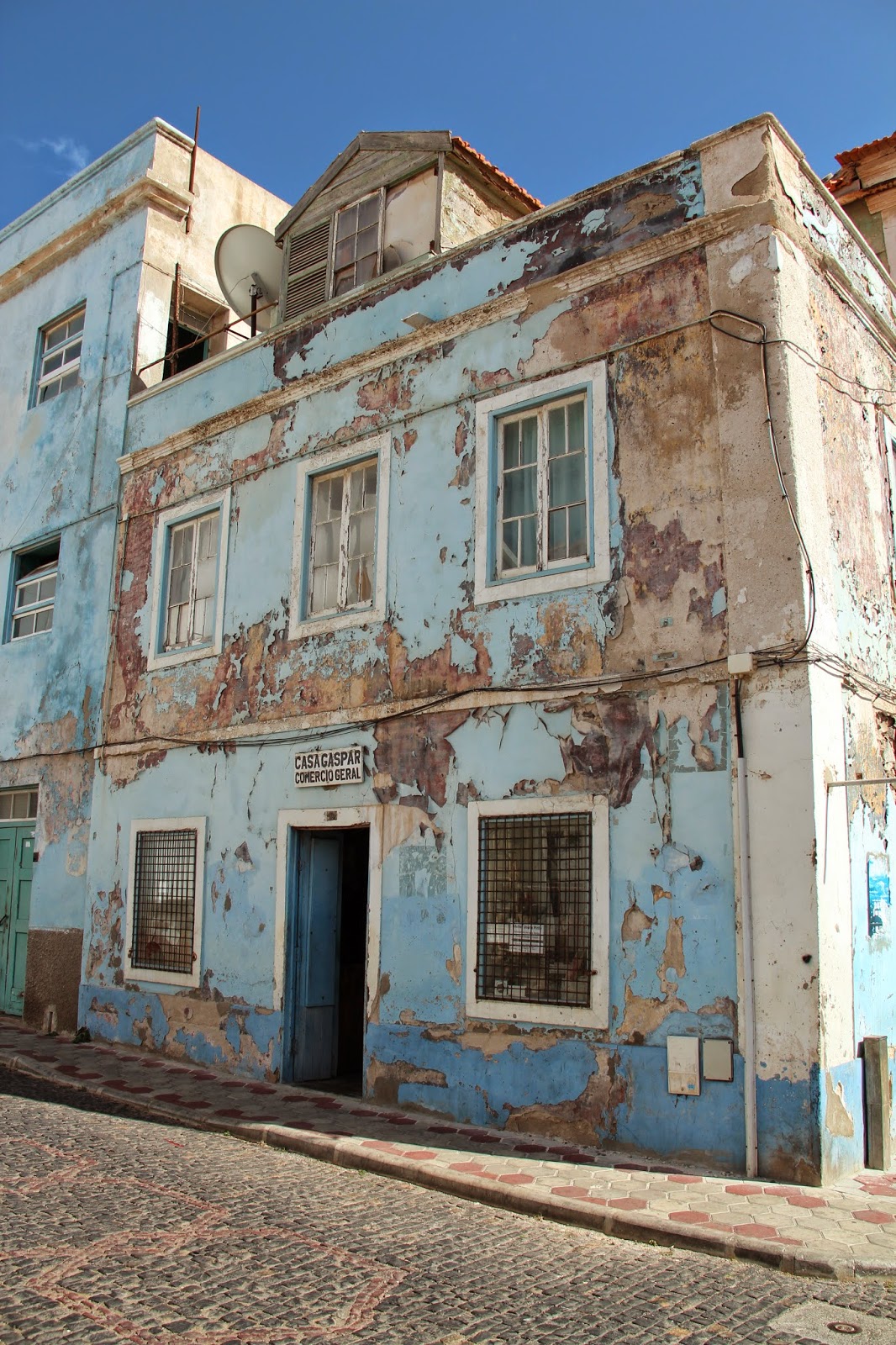
One of the last stops of our tour around Mindelo was the old school building Jorge Barbosa / Gil Eames. It is a fascinating place, run-down, but still it's clear that the school has a long story. Amílcar Cabral was a pupil there, and many other cape verdeans as well. You can find old photos of the building here.


We really enjoyed Mindelo, it felt a bit like breathing freely again after the slightly tense atmosphere we experienced in some places on Santiago. And we were excited to depart for the last island we wanted to visit: Santo Antão.